“Blessed are those who hunger and thirst for righteousness, for they shall be satisfied.”
Matthew 5:6 (ESV)
“The root cause of our nation’s woebegone predicament is greed, the very bedrock of all other deadly sins.”2
Introduction
Matthew 5:6 has something important to say to the Philippines today. The recurring problem of corruption continues to endanger communities and undermine public trust. The corruption in flood control projects has made Filipinos even more aware that funds intended to protect people from natural disasters are regularly misused, diverted, or pocketed—binulsa. Filipinos, especially the poor and those living in flood-prone areas, suffer from this injustice. Reading Matthew 5:6 through this lens not only addresses personal spirituality but also reminds Filipino evangelicals of their prophetic responsibility to challenge the structural injustices that continue to cause hardship for Filipinos. While avoiding generalization, I hope that for Asian Christians, many of whom live amidst systemic inequality and environmental crises, this beatitude may become a call to seek justice and to bear witness to God’s righteousness as people called to be salt and light.3
This call aligns with C. Paul Mojica’s elaboration of the lowland Filipinos’ concept of pananagutan (accountability). He explains that complacency and negligence are equivalent to burying or hoarding one’s gifts or talents. More importantly, failing to act responsibly dishonors the higher authority (society, conscience, or God) that placed trust in individuals.4 It is especially imperative to act justly where corruption is rampant. Economics professor Cielo Magno and Jake Ragala capture this vividly in their song, powerfully titled, “Tax Ng Ina Mo, Bantayan Mo!” The song reminds us that protecting public resources is a moral duty.
My perspective on the Beatitudes (part of the Sermon on the Mount) is highly influenced by theologian Stanley Hauerwas. For Hauerwas, Jesus is the Sermon on the Mount. He explains that to know what the Sermon on the Mount means is to look at Jesus’s life, so that one could learn to live with him and be like him. In other words, the Sermon on the Mount is not just a set of moral principles, a list of rules, or abstract ethics that Christians try to apply. Rather, it is a description of Jesus’s own life and way of being in the world.5 This way of applying the Beatitudes forms a community of people whose lives take the shape of Jesus’s life. The church exists in the world to make visible what Jesus looks like when his way of life is lived out together in community. Hauerwas asserts that the Sermon on the Mount shows a “kind of life that God has made possible for Christians to live within the sphere of God’s reign.”6 Consequently, Christians have to embody a social alternative that shows God’s way of living, a way the world cannot naturally come up with by itself.7
In this case, the church’s primary role is to be true to itself as an alternative community that reflects God’s reign and righteousness. Being an alternative community does not mean turning away from society. Instead, Christians are called to minister to the world so that the world would know that it is the world.8 Or in Hauerwas’s words: “My concern has always been to help Christians understand we cannot and should not avoid engagement with the world.”9 I am emphasizing the term alternative community to show that what makes the world “the world” is its refusal to acknowledge Jesus’s resurrection and submit to his lordship.10 This refusal distorts the “good life” and gives rise to corruption and selfishness. The “good life” here means shalom. It is the holistic flourishing of our relationship with God, our neighbors, ourselves, and creation.
Greed and Corruption
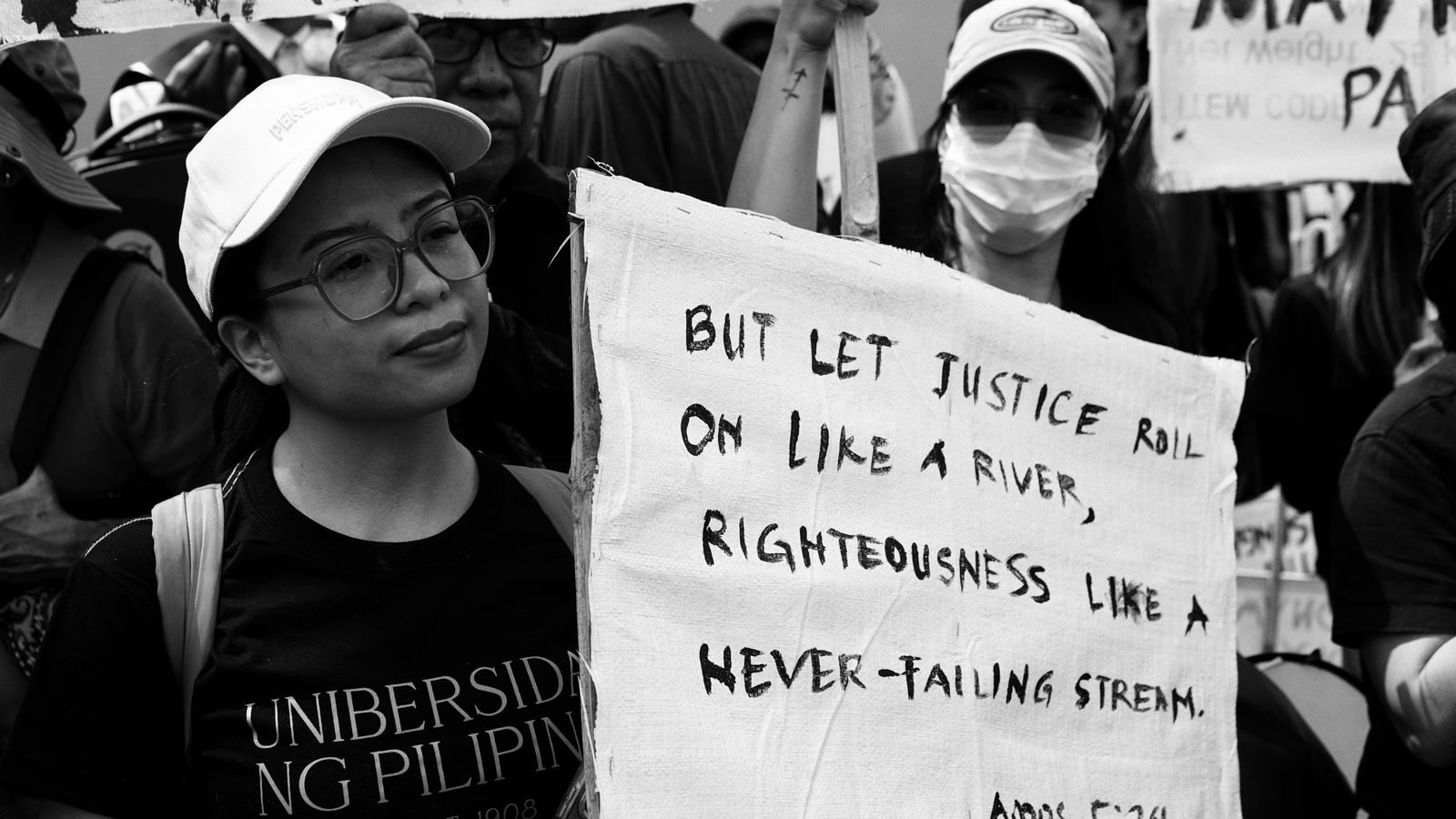
In 2025, almost simultaneously, citizens of Nepal, Indonesia, and the Philippines protested in the streets against the rampant corruption of their governments. In Nepal, anger grew, especially among Gen Z, against the social media ban, political favoritism, and corruption.11 In Indonesia, outrage followed revelations of parliamentarians living extravagant lifestyles while most citizens experienced hardship.12 In the Philippines, corruption in flood control projects led to large protests.13 The protests demanded honesty, accountability, and real, significant change. It was discovered that many government-funded flood control projects exist only on paper. Government employees released billions of funds to anomalous contractors and builders at overpriced budgets, and then recorded the projects as completed despite little, defective, or no actual work being done. The discovery of the corruption came at a time when heavy monsoon rains caused floods that destroyed homes and infrastructure and displaced people. This made the public see the problem not just as poor management, but as an injustice and a moral betrayal.14
The Philippines frequently faces natural disasters, especially flooding. Globally, the Philippines ranks first as the most vulnerable to natural disasters. The country continues to struggle with both the environmental and socio-economic results of catastrophes. Since the poor and vulnerable experience the most severe consequences, the issue of flood control and corruption should not be divorced from our theological understanding of righteousness. The church’s prophetic voice “must be heard, and this voice must challenge all the people in society to become deeply involved in addressing this problem.”15
The anomalous flood control projects involved not only government employees but politicians in the high seats of power–some of them are even avowed evangelicals.16 The widespread anger of Filipinos toward corruption ought to challenge evangelicals to a more robust discipleship that does not separate faith from civic duty.17 Public theology calls Filipino evangelicals to let their protest against unrighteousness bear witness to God’s justice. While it is impossible to achieve a perfect society, pervasive corruption threatens a peaceful and orderly community. Corruption destroys our vision of life, our relationships (with others, the environment, and ourselves), and our value systems. Asian evangelical theologians ought to address corruption explicitly, because theology must not overlook the ethics of human dignity, righteousness, and “the good life.”18
A Cry for Righteousness
Hauerwas argues that when we see the Sermon on the Mount primarily as a set of moral rules, “we lose sight of the fact that this is a sermon preached by Jesus. It makes all the difference who the proclaimer is, namely, Jesus, the Jesus who proclaimed the inauguration of a new age. And he does not just proclaim it, he is the inauguration of that age.”19 In short, Jesus is the model and is not to be separated from discussions of the Beatitudes.
Jesus describes the desire to hunger and thirst for righteousness as a profound, urgent aspiration for God’s presence and ways. Righteousness includes living in a right relationship with God, seeking to embody moral integrity, desiring justice and compassion, and letting God’s values shape our personal life and, through us, the world around us. Jesus promises that this deep internal craving will be met. God’s people will be filled with righteousness by God himself, gaining a deep sense of spiritual fulfillment in this life and in God’s kingdom, where justice will be fully restored, and all things will be made perfect. In short, a kingdom “where God’s gracious rule is established.”20
The question is, what has righteousness to do with justice? Annelle Gumihid-Sabanal is helpful in this regard. She explains:
Justice almost always stands synonymously with the idea of “righteousness,” whether explicitly or conceptually. In the modern perspective, righteousness is usually understood in the modern sense of “being holy.” It implies moral uprightness due to one’s belief in God. . . . However, in the prophetic material, righteousness carries the notion of the right order of things following the standards of God’s rightness. Hence, righteousness means doing what is just, and justice implies doing what is right. Both concepts are always related to an act of “doing.”21
Put another way, righteousness is fundamentally connected to the pursuit of justice. This connection becomes more evident when we look at “Tax ng Ina Mo, Bantayan Mo!” which critiques corruption and resonates with Filipinos’ everyday experiences of injustice.
That’s Why “Tax ng Ina Mo, Bantayan Mo!”
The song’s title urges Filipinos to watch where the taxes paid by their parents or their mothers go.22 The literal English translation is “It’s your mother’s taxes, guard them!” “Tax ng Ina Mo” is a play on the curse “’Tang ina Mo! (Your mother is a whore).” No doubt, the title expresses strong emotions. Before you wonder why I used a somewhat un-Christian-like term here, please understand that the song expresses satirical frustration. In exasperation, the song encourages young people not to ignore corruption because it affects their lives.
The song’s critique of corruption and misuse of taxpayers’ money has attracted considerable attention.23 Filipinos can easily understand its humor. The song challenges the next generation to be aware of this systemic corruption. It is a call to discernment and accountability; a reminder of our prophetic calling, embodying a hunger for good governance, which is part of righteousness.
“Tax ng Ina Mo, Bantayan Mo!” resonates with Filipino evangelicals because, through humor and satire, it mirrors the everyday reality of societal corruption that Matthew 5:6 calls believers to confront. Although the song is satirical, it is also educational; it exposes injustice in a way that is both relatable and thought-provoking. It thus reminds us that our faith is not only spiritual but also practical. Just as Matthew 5:6 calls us to hunger and thirst for righteousness, “Tax ng Ina Mo, Bantayan Mo!” invites us to see the reality of injustice, which could motivate us to act with integrity and civic responsibility.
Why is this important? Filipino Christians are challenged to care for the oppressed, the very people whom Jesus Christ devoted his life to.24 Unfortunately, this responsibility is often neglected. Pablo Virgilio Cardinal David says that “the root of corruption is indifference.”25 Filipino evangelical scholar Federico Villanueva also notes this indifference, stating, “Even when there are injustices happening right before our eyes comparable to those which Habakkuk saw, many Christians remain silent.”26 Villanueva recounts attending a conference of Filipino biblical scholars. After one presentation, he asked about the relevance of the paper to the Philippine context. Interestingly, a Filipino thinker sitting next to him tapped him and advised him not to raise application-related questions because the gathering was focused mainly on biblical studies or the “world behind the text.” For Villanueva, one possible reason for this is that many Bible scholars today focus mostly on the historical background of the Scripture, such as what happened long ago and what the text originally meant, without connecting it to what is happening in our society today.27
Since the 1970s, theologians C. René Padilla and Samuel Escobar have been calling Christians to implement integral mission. That mission includes salvation from the effects of sin manifested in oppression, injustice, and chaos. Miguel Echevarria argues that many North American evangelicals (who have influenced Filipinos) have been more concerned about souls going to heaven and have therefore dismissed Padilla and Escobar’s message.28 We must all be reminded that Christ is also concerned with our struggle here on earth, including with injustice and corruption, because “the church is part of Christ’s continuing story in the world.”29
The concept of the kingdom of God as presented in the Sermon on the Mount highlights God’s authority and dominion. The concept of righteousness is also integral to God’s kingdom, as it guides people to live justly. As such, God’s kingdom has a social aspect because of Jesus’s reconciling work between God’s kingdom and this world. The church, as God’s instrument, serves as an antithesis to injustice and in solidarity with the oppressed.30 To conclude, Matthew 5:6 can serve as an encouragement for evangelicals to confront systemic corruption and social inequality. The corruption in the flood control projects provides an opportunity for Filipino evangelicals to not only advocate for effective disaster management but also to fulfill their prophetic role by holding the government accountable. In light of Matthew 5:6, Asian evangelicals are called to address the structural injustices and to demand integrity and transparency. Desiring righteousness aims for wholeness and harmony (shalom) among us and within our community.31
The Sermon on the Mount does not make sense to those who are not part of and shaped by the church. Only a community sustained by the Holy Spirit can fully grasp the meaning and repercussions of the Beatitudes. That assertion challenges the individualistic approach that teaches one to focus on oneself.32 Thus, the formation or sanctification of believers is not for private holiness alone but also for faithful public witness. The Holy Spirit sustains the church to speak and act on behalf of justice, even when our words and actions could be costly. The Spirit of God both gathers us and sends us as an alternative community called to live as salt and light in this world. As Charles Ringma says, “We have come ‘home’ through the grace of God in Christ, and we are also ‘sent out’ by the impulse and movement of the Spirit.”33 Therefore, “Tax ng Ina Mo, Bantayan Mo!”
***I declare that this is my own work, not from AI. I am grateful to Dr. Bruce Barron of the World Evangelical Alliance’s Evangelical Review of Theology for his helpful comments on the earlier draft of this manuscript.***
- 1 “It’s Your Mother’s Taxes, So Guard Them!”
- 2 Philippine Daily Inquirer, “Control the Flood of Greed: Lessons for Future Generations,” Inquirer.net, October 10, 2025, https://opinion.inquirer.net/186641/control-the-flood-of-greed-lessons-for-future-generations.
- 3 See Rolex M. Cailing, “The Reign of God in and through the Messiah,” in Ama Namin: The Lord’s Prayer in Philippine Life and Spirituality, ed. Timoteo D. Gener and Jason Richard Tan (Carlisle, UK: Langham Global Library, 2023), 81.
- 4 C. Paul Mojica, “Pananagutan: A Multifaced Framework for Filipino Theological Ethics of Responsibility,” International Journal of Asian Christianity 8 (2025): 47.
- 5 Plough, “Stanley Hauerwas on His New Book: Jesus Changes Everything,” 1:37–2:32, accessed January 15, 2026, https://www.youtube.com/watch?v=9pOnN7yRFXM.
- 6 Stanley Hauerwas, “Living the Proclaimed Reign of God: A Sermon on the Sermon on the Mount,” Interpretation 47, no. 2 (April 1993): 152.
- 7 Stanley Hauerwas and William H. Willimon, Resident Aliens: A Provocative Christian Assessment of Culture and Ministry for People Who Know that Something is Wrong (Nashville, TN: Abingdon Press, 1989), 18.
- 8 Stanley Hauerwas, A Community of Character: Toward a Constructive Christian Social Ethic (Notre Dame, IN: University of Notre Dame Press, 1981), 10. For Hauerwas, the church helps society the most not by controlling it, but by forming people who are honest, patient, courageous, and loving enough to tell the truth and listen to others, even when it is difficult. Stanley Hauerwas, Performing the Faith: Bonhoeffer and the Practice of Nonviolence (Grand Rapids: Brazos Press, 2004), 15.
- 9 Hauerwas, Performing the Faith, 14.
- 10 Stanley Hauerwas, The Work of Theology (Grand Rapids: Wm. B. Eerdmans, 2015), 124.
- 11 Ritesh Panthee, “Nepal’s Gen Z Protests: Corruption, Censorship, and a Government Under Fire,” The Diplomat, September 9, 2025, https://thediplomat.com/2025/09/nepals-gen-z-protests-corruption-censorship-and-a-government-under-fire/?
- 12 Agence France-Presse, “Thousands Protest in Indonesia as Military Deployed in Capital,” Inquirer.net, September 1, 2025, https://globalnation.inquirer.net/289826/thousands-protest-in-indonesia-as-military-deployed-in-capital.
- 13 Lyza Aquino, “Thousands Join ‘Trillion Peso March’ at EDSA to Protest Corruption,” September 21, 2025, https://www.abs-cbn.com/news/nation/2025/9/21/thousands-join-trillion-peso-march-at-edsa-to-protest-corruption-1609.
- 14 Jenan Naz, “Strategic Antagonism and the Flood Control Scandal: Blame-Seeking, Performative Accountability, and Institutional Routing in the Philippines,” The International Journal of Business Management and Technology 9, no. 12 (December 2025): 9.
- 15 Fritz W. de Wet and Ferdi P. Kruger, “Blessed are Those that Hunger and Thirst for Righteousness: Sharpening the Ethical Dimension of Prophetic Preaching in a Context of Corruption,” Verbum et Ecclesia 34, no. 1 (2013): 1.
- 16 Rappler IQ, “Congress, Contractors, Conflict, Corruption: A List of Rappler Exclusives,” Rappler.Com, October 7, 2025, https://www.rappler.com/newsbreak/iq/list-exclusive-stories-congress-contractors-conflict-interest-corruption-flood-control-infrastructure-dpwh/; Athena Charanne Presto, “Flooded by Corruption, Filipinos Use Online Lifestyle Checks as Political Pushback,” September 15, 2025, https://www.internationalaffairs.org.au/australianoutlook/flooded-by-corruption-filipinos-use-online-lifestyle-checks-as-political-pushback/.
- 17 Aldrin M. Peñamora and David S. Lim, eds., Faith and Politics: Filipino Evangelical Insights in Political Theology (Carlisle, UK: Langham Global Library, 2025).
- 18 de Wet and Kruger, “Blessed are Those that Hunger and Thirst for Righteousness,” 1–10.
- 19 Hauerwas, “Living the Proclaimed Reign of God,” 154.
- 20 Cailing, “The Reign of God in and through the Messiah,” 73.
- 21 Annelle G. Sabanal, “‘Act Justly, Love Mercy, Walk Humbly with God,’: Perspectives on Power and Politics from the Old Testament Prophetic Tradition,” in Faith and Bayan: Evangelical Christian Engagement in the Philippine Context, ed. Lorenzo C. Bautista, Aldrin M. Peñamora, and Federico G. Villanueva (Carlisle, UK: Langham Global Library, 2022), 35.
- 22 Cielo Magno and Jake Regala, “Tax Ng Ina Mo,” accessed November 21, 2025, https://www.youtube.com/watch?v=LD8a6DazQVc.
- 23 Jay Hilotin, “Philippine Protests: ‘Tax ng Ina Mo, Bantayan Mo!’ Rap Song Sparks New Wave of Vigilance,” Gulf News, Entertainment, September 22, 2025, https://gulfnews.com/entertainment/music/philippines-tax-ng-ina-mo-bantayan-mo-rap-song-sparks-new-wave-of-vigilance-1.500278360.
- 24 Federico G. Villanueva, “Worship and Justice,” in Faith and Bayan: Evangelical Christian Engagement in the Philippine Context, ed. Lorenzo C. Bautista, Aldrin M. Peñamora, and Federico G. Villanueva (Carlisle, UK: Langham Global Library, 2022), 15.
- 25 Dianne Sampang, “Indifference is Root of Corruption, Suffering,” Inquirer.net, September 28, 2025, https://newsinfo.inquirer.net/2116548/indifference-is-root-of-corruption?fbclid=IwRlRTSANFxaFleHRuA2FlbQIxMQABHkRU0GWKdN_fo-i3GKI8BSdhlp_8n4RfQjPZp4d9BdgLrs7ZJNPv7JNA4vJZ_aem_5G1sEeGlbk86EJtVu-AbiQ.
- 26 Federico G. Villanueva, “Why the Church Needs to Learn How to Complain and Not Just ‘Trust and Obey,” Faith and Bayan: Evangelical Christian Engagement in the Philippine Context, ed. Lorenzo C. Bautista, Aldrin M. Peñamora, and Federico G. Villanueva (Carlisle, UK: Langham Global Library, 2022), 93.
- 27 Federico G. Villanueva, “Ano’ng Talata sa Biblia ang Bagay sa Dutertismo? Relihiyon Bilang Kasangkapan sa Giyera Kontra Droga,” Hapag 22, no. 1 (2025): 137.
- 28 Miguel G. Echevarria, Jr., “Middleton and Wright Have We Loved, but Padilla and Escobar? North American Eschatologies and Neglected Latino Voices,” Southeastern Theological Review 11, no. 2 (Fall 2020): 47, 51, 53.
- 29 Tish Harrison Warren, Introduction to Stanley Hauerwas, Jesus Changes Everything: A New World Made Possible (Walden, NY: Plough Publishing House, 2025), xviii.
- 30 de Wet and Kruger, “Blessed are Those that Hunger and Thirst for Righteousness,” 4.
- 31 Sabanal, “‘Act Justly, Love Mercy, Walk Humbly with God,’” 35.
- 32 Hauerwas, “Living the Proclaimed Reign of God,” 153.
- 33 Charles Ringma, In the Midst of Much-Doing: Cultivating a Missional Spirituality (Carlisle, UK: Langham, 2023), 26–27.

Francis Jr. S. Samdao earned his Doctor of Theology from Asia Baptist Graduate Theological Seminary. He is an assistant professor of theology at the Philippine Baptist Theological Seminary and assistant editor of the World Evangelical Alliance’s Evangelical Review of Theology. He is the author of the book Drinking Coffee with Some Contemporary Filipino Evangelical Theologians. He is married to Shilo Rose Tacay-Samdao.