| November 5, 2026
Faith and Suffering: Reflecting on the Problem of Evil in the Filipino Context
Introduction
Ask a seminary student in the American Midwest why a good and all-powerful God allows evil, and you’ll likely be taken through discussions of free will, Irenaeus’ soul-making theodicy, or Alvin Plantinga’s free-will defense.1 These are answers to questions shaped by particular settings, and they do not always address the concerns of those who suffer elsewhere. Sit with a Filipino widow whose home has been swept away by a typhoon for the third time in a decade, or with the family of a Korean factory worker who died from exhaustion, or with an Indian Christian whose neighbors insist that her disabled child is suffering for sins committed in a previous life. In these moments, some aspects of Western Christian thought can seem worlds away.
This is not a criticism of any Western theology. It is simply an observation that making sense of evil and suffering in light of God’s goodness and power, what theologians commonly call theodicy, is never undertaken in a vacuum. People always do it in particular places, shaped by particular histories and cultural assumptions. When evangelical churches in Asia simply import theodicies developed for different contexts, they risk offering answers that are logically sound yet pastorally disconnected. They risk failing the very people they are meant to console instead of building on them to open ways of addressing grief and orienting believers toward recovery. What, then, might faithful evangelical reflection on suffering look like when it starts from the questions and thought forms of particular Asian contexts?
Theodicy in a Filipino context
I suggest that any such theodicy must begin by reckoning with two deeply rooted convictions that, in my local context, shape how ordinary believers respond to suffering long before they encounter the philosophical “problem of evil.” The first concerns who God is. Broadly speaking, Filipino religious culture still believes in the existence of God, and that belief tends to carry the assumption of a being who is both good and powerful.2 The second concerns why suffering happens. There is a tendency to read tragedy as the consequence of one’s transgressions or of a disruption to social order. Together, these two convictions shape the pastoral task in the Philippines more than any imported theodicy. Each of these is taken up in turn below.
Where God is never questioned
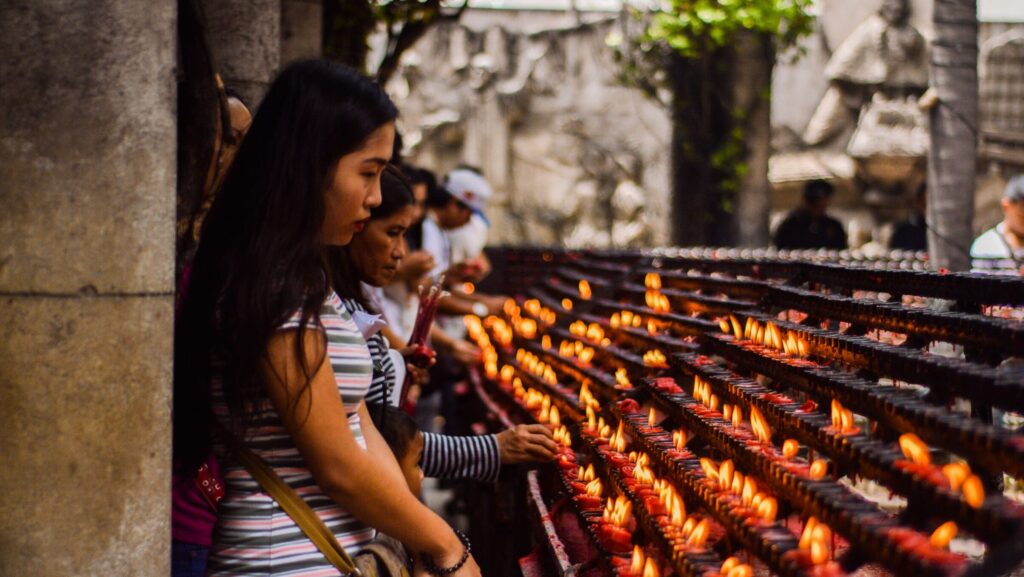
The first conviction is an unwavering belief that God is both good and powerful. Consequently, questioning God’s existence is almost unthinkable. When tragedy occurs, such as a freak accident, a devastating illness, or the death of a loved one, the instinctive response is often the cry, Diyos ko po! (“Oh my God!”). In most Filipino contexts, this is not an act of blasphemy or a careless use of God’s name. Rather, it is an anguished cry of faith, an appeal for God to intervene, rescue, remove the pain, and demonstrate his goodness and power.
Behind this cultural instinct lies an important theological assumption. Because God is sovereign and powerful, questioning him may invite further or prolonged suffering. One does not challenge the One who ultimately governs one’s fate. God’s goodness and power are simply assumed, and in many cases no amount of suffering could put them in doubt. Drawing from a Jesuit scholar, Dave Johnson understands Filipino folk religion as marked by the coexistence, within one person, of thought-and-behavior systems that do not cohere with one another.3 This helps explain why a firm conviction about God can sit alongside other beliefs about fate, spirits, and appeasing unseen powers without feeling contradictory to the believer. A Filipino family may hold firmly to an affirmation of divine goodness without feeling any need to justify it in the face of tragedy.
I grew up assuming I had faith, but I never knew that faith was meant to seek understanding. The philosophical problem of evil was something I had to learn to ask. Perhaps many young evangelicals first encounter the classical “problem of evil” only after entering Sunday school, Bible college, or university. That was certainly my experience. Until then, I had never considered that suffering could be used as an argument against God’s existence. J. D. Principe substantiates this in his work as he observes survivors of calamity. “There is bitterness, they said, and there is questioning of why such things are happening, but this questioning never translates into a wonder about whether or not God exists.”4 The assumption that one might question God because of evil was itself foreign in such contexts.
“The wages of sin is ‘misery’”
If God’s goodness and power are beyond question, then suffering must be explained some other way. This is the second conviction, and it is perhaps the more firmly established maxim. Suffering is assumed to be a consequence of someone’s sin. People often interpret personal tragedies as divine retribution for one’s own wrongdoing, or even for the sins of family members. Again, Principe’s work is particularly important here. He writes about the natural disasters that have struck the country in recent years, and he notes that the language people reach for to describe calamities is telling. Biblical allegories such as “cleansing,” “punishment,” and even “Sodom and Gomorrah” recur alongside the religious conviction that tragedies function as trials of faith.5
This way of thinking also shows up in conversations about daily ordeals. A family’s repeated misfortunes may be attributed to a spouse’s marital infidelity. A fatal car accident may be interpreted as God’s judgment because the vehicle had been used to transport a secret lover. It is not uncommon to hear someone say, Nagdala ka ng sumpa sa tahanan na ito (“You brought a curse upon this household”).6 Suffering is understood not as mysterious or random, but as comprehensible within the context of divine moral order. Someone sinned, and God responded. Rito V. Baring describes the theological logic behind this thought and distinguishes a retributive framework from a redemptive one:
In the retributive framework, the justice of God is the greater good which justifies the suffering of an individual. Building up on the redemptive mindset, the redemptive model provides that human suffering is justified for the sake of personal conversion which in this case is the greater good. Within this thinking, human suffering serves divine justice either as a deserved punishment for the offender who offended God or as a necessary step towards the attainment of eventual personal maturation and growth.7
Francis Samdao makes the same observation, but he points out that this is not the only way Filipinos explain suffering. At other times, people see disasters as a test of faith. Or they take disasters as evidence that God offers to strengthen belief rather than punish sin.8 What I find most interesting is what Samdao does with the idea that suffering is not random. Rather than simply accepting that disaster equals punishment for personal sin, he redirects attention toward structural and ecological dimensions of human sin. He points to the greedy, careless, power-hungry systems humans have built. Deforestation, pollution, and unchecked “progress” all make disasters far worse than they would otherwise be. Samdao borrows Karl Barth’s term “lordless powers”9 to describe the tools and systems we built to serve us that end up ruling over us. That reframing might actually be useful in our discussion. It lets us keep a recurring Filipino instinct that suffering means something. Suffering is not just random bad luck. At the same time, it moves the blame away from the question of what sin a person committed or how tragedies negate the existence of God. It locates the problem to the structural evil we are all caught up in together.
When suffering is always a verdict
Although the retributive understanding that disasters follow human sin does not represent every Asian context, it would not be surprising to find that it resonates with many communities in provincial, rural, and indigenous communities across the Philippines, where it is often voiced, interestingly, in the vernacular of karma. If this framework shapes how suffering is instinctively interpreted, what responsibility does that place on theological reflection? The classical project of theodicy, from Irenaeus and Augustine to Aquinas and the Reformers, still offers valuable resources, but it must take root in the questions communities in Asia are actually asking and with careful attention to the indigenous concepts already shaping how they understand suffering. Before defending God’s existence against philosophical objections, an Asian evangelical theology may first need to challenge the deeply ingrained assumption that every instance of suffering is God’s direct punishment for human sin. In many contexts, the pastoral task is not merely to explain why God permits evil but to proclaim, as the Book of Job ultimately does, that not all suffering is retributive and that God’s purposes often exceed the moral accounting of human observers. Job’s friends insist that his suffering must be punishment, and God rebukes them for it. Yet the book never questions God’s existence and rule. Here Scripture does what contextual theodicy is meant to do by affirming divine sovereignty and challenging the assumption that we know why God does something just by working out what seems fair, sensible, or what we think people have coming.
An invitation to develop local theodicies
This recommendation, I want to suggest, is only a starting point, and I offer it as an invitation rather than a conclusion. Insofar as many already possess convictions about the nature of God and the moral dimensions of suffering, such convictions ought not be treated as mistakes in their entirety to be corrected by some theodicy brought in from outside. In our case, the innate perception of blessing and curse and the felt need to place suffering within a moral order both already operate as a kind of rudimentary theodicy. The task before those who study God’s dealings with suffering, then, is not simply to select a more adequate theodicy from elsewhere and hand it down. It requires the slower, more attentive work of excavation. They must sit with the prayers, proverbs, funeral rites, and folk explanations of a given community. They must ask what theological instincts already animate them. Then they must bring those instincts into sustained conversation with Scripture. Other Asian and Majority World contexts will surely yield their own rudimentary theodicies shaped by their own histories and idioms of suffering. I hope this reflection on the Filipino case invites others to undertake a similar excavation of their own. This is not to romanticize indigenous thought forms uncritically, particularly in light of Scripture, but to take seriously that God may already be at work within them.
- 1 For examples of how the problem of evil is commonly taught in North American seminaries, see the syllabi for “God, Suffering and Evil” (McCormick Theological Seminary, Spring 2002) and “The Problem of Evil” (New Orleans Baptist Theological Seminary, PHIL 6305, 2021), both organized around Augustinian, Irenaean (Hick), and free will (Plantinga) approaches; see also Stephen T. Davies, ed., Encountering Evil: Live Options in Theodicy (Westminster John Knox Press, 2001). For Asian critiques and alternatives, see Andrew S. Park, The Wounded Heart of God: The Asian Concept of Han and the Christian Doctrine of Sin (Abingdon Press, 1993); Kazoh Kitamori, Theology of the Pain of God (John Knox Press, 1965). Irenaeus of Lyons (c. 130-202) taught that humans were not created perfect but immature, and meant to grow over time into the likeness of God. The philosopher John Hick later developed this idea into what is now called the “soul-making” theodicy. In this view, a world with no hardship or danger could not produce moral courage, compassion, or maturity, so the struggles of earthly life are the setting in which character is formed. Hick presents this as an alternative to the older Augustinian view that evil results mainly from a fall from original perfection. See John Hick, Evil and the God of Love (Palgrave Macmillan, 2010). Alvin Plantinga’s argument responds to the “logical problem of evil,” which holds that it is contradictory to believe in an all-powerful, wholly good God and also in the existence of evil. Plantinga does not claim to explain why God allows evil. He argues only that there is no contradiction. It is possible, he says, that God could not have created a world with genuinely free creatures and also guaranteed they would never choose wrongly, so that the possibility of evil is the cost of a world containing real freedom and real love. If that is even possible, the charge of logical inconsistency fails. See Alvin Plantinga, God, Freedom, and Evil (Wm. B. Eerdmans Publishing Co., 1977).
- 2 Elise Winland, “Pew: Philippines Remains One of the World’s Most Religious Countries, Overwhelmingly Catholic,” Zeale, July 2, 2026, https://zeale.co/news/articles/pew-philippines-remains-one-of-the-worlds-most-religious-countries-overwhelmingly-catholic. This news article summarizes Pew’s 2026 findings that 92% of Filipino adults are Christian, including 76% who are Catholic.
- 3 Dave Johnson, “A Christian Response to the Filipino Understanding of National Disasters,” Journal of Asian Mission 18, no. 2 (2017): 52.
- 4 Jesus Deogracias Principe, “Writing the Disaster: A Philippine Case Study of the Challenge to Traditional Theodicy in Popular Media,” Journal for the Study of Religions and Ideologies 14, no. 42 (2015): 185.
- 5 Principe, “Writing the Disaster: A Philippine Case Study of the Challenge to Traditional Theodicy in Popular Media,” 177–78. Johnson also explains that even Filipinos upholding Roman Catholic faith “believe that the Virgin Mary and Roman Catholic saints can prevent natural disasters and that some may be involved in causing them” (“A Christian Response to the Filipino Understanding of National Disasters,” 53). Disaster response is thus to be seen as part of a transactional relationship with heavenly patrons.
- 6 On this point, Rito V. Baring surveys 300 Filipino adults and finds four dimensions in how they understand suffering: (1) it draws a person to God; (2) it stems from corrupt human tendencies; (3) it is essential to human life; and (4) it reflects broken relationships. In other words, many Filipinos still interpret suffering mainly through their relationship with God and with others, and not through the question of why evil exists, (“Theological Reflections about Adult Filipino Notions of Suffering Today,” Philippiniana Sacra 44, no. 130 [2009]: 21–48)in.
- 7 Baring, “Theological Reflections about Adult Filipino Notions of Suffering Today,” 42.
- 8 Francis Jr. S. Samdao, “Establishing ‘Mordor’ in God’s Creation: Natural Disasters, Barth’s ‘Lordless Powers,’ and Filipino Indigenous Beliefs,” Philippine Journal of Religious Studies 4 (2024): 46.
- 9 Samdao, “Establishing ‘Mordor’ in God’s Creation: Natural Disasters, Barth’s ‘Lordless Powers,’ and Filipino Indigenous Beliefs,” 47–48.

C. Paul Mojica is a faculty member at the Center for Biblical Studies and has served as Pastor-Elder of FCF–Baguio Mission Center since 2009. He contributes to collaborative works in philosophy and serves as an editor for Wise Ideas Publication. His recent work in contextual theology appeared in the International Journal of Asian Christianity (Brill), while his study on Patristic theology was published in Theo Global Journal, Vol 2: The Crown of Creation. He is currently pursuing a PhD in Theological Studies at AGST. Paul and his wife, Pauline, homeschool their children, Paull Amos and Psalm Ayla.