
| November 12, 2026
Overturning the Tables: Following Jesus into the Public Square
Introduction
After listening to a presentation on faith and politics, a colleague asked me, “What theological or biblical framework do we use for church societal engagement?” His question prompted me to reflect on Scripture and the mission of the church, leading to an ongoing personal inquiry into public missiology.
In the Philippines, corruption is not merely an abstract academic concept discussed in universities but a lived social reality. It is manifested in the embezzlement of public funds, patronage politics, vote-buying, bureaucratic inefficiency, and systemic injustices that leave much of the country weak and vulnerable.
Although corrupt practices have existed since the founding of the Philippine Republic, what is particularly alarming today is the breadth, depth, and normalization of corruption and injustice in our nation, as evidenced by the hundreds of billions of pesos lost in the recent flood control issue. These problems affect the legislative bodies, segments of the judicial system, law enforcement, and even some religious organizations, all of which have been weakened by the corrosive effects of greed.1 These conditions create social instability, as basic government services and meaningful economic opportunities leave many people struggling to meet their families’ basic needs, which could foster violent protests2 or lead to the growth of criminality.3
In addition, the anti-drug campaign of the previous administration may have reinforced a punitive climate in which some individuals came to view extralegal violence as an acceptable means of pursuing justice. Research on punitive attitudes among Filipinos reveals that some citizens support harsh punishments and even extralegal measures to address perceived social problems. While the research does not establish a direct link between the campaign and an increase in specific crimes, it raises important questions about the normalization of violence, public trust in legal institutions, and the tendency to favor retribution over due process.4
This context raises urgent questions about the church’s role in nation-building, the ongoing task of shaping a society marked by justice, integrity, and the common good. Nation-building goes beyond political activity or government programs; it involves forming values, institutions, and social relationships that enable a nation to flourish.
When discussing the church’s mission, many Evangelicals understand it primarily in terms of evangelism, religious conversion, and church planting, leaving questions of public engagement largely unresolved. Politics is often regarded as inherently dirty, and involvement in it is often assumed to inevitably lead to moral compromise. At the same time, some interpretations of Romans 13 have been used to discourage Christian participation in civic dissent, emphasizing submission to governing authorities and replacing public engagement with private prayer.5 The church cannot stand idle and watch on the sidelines as our nation is exploited by abusive and corrupt leaders. We need to develop a robust theology of mission that includes public life.6
Public missiology, a recently coined term, affirms that God’s redemptive work extends beyond individual salvation to the renewal of public life. The church is therefore summoned to participate responsibly in the nation’s public sphere as a witness to God’s justice, righteousness, and shalom, a foretaste of God’s Kingdom on earth.7
Jesus’ Cleansing of the Temple as a Model of Public Missiology
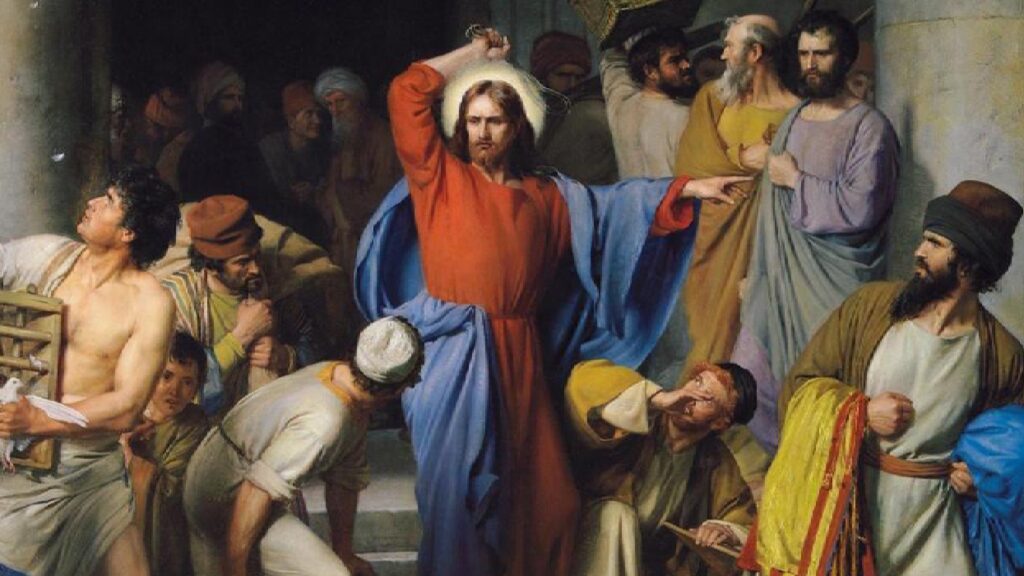
Matthew 21:12–14 offers a compelling paradigm for this public dimension in our theology of mission. Jesus’ cleansing of the Temple (also Mark 11:15–17; Luke 19:45–46; John 2:13–17) was a prophetic confrontation with systemic injustice embedded within a religious institution. By overturning the money changers’ tables and driving out those who exploited worshippers, Jesus exposed the corruption of a structure meant to embody justice and righteousness.
His declaration that the Temple was to be a “house of prayer” rather than a “den of robbers” demonstrates that personal holiness cannot be separated from social responsibility. The narrative then concludes with the healing of the blind and the lame (Matt. 21:14)
Jesus’ cleansing of the Temple invites Filipino Christians to reconsider their theology of mission not merely as soul-conversion but as faithful participation in God’s redemptive work in the public square.
The Temple as a Site of Systemic Injustice
The Temple functioned not only as a religious center but also shaped Jerusalem’s political and economic significance; “it was the city of the Temple.”8 The Temple symbolized Israel’s covenant with Yahweh and embodied God’s vision of justice, holiness, and even inclusion. Quoting Isaiah, Jesus declared that God’s house should be a “house of prayer for all nations” (cf. Mark 11:17; Isa. 56:7). Isaiah 56:1–7 affirms the inclusion of foreigners and eunuchs, while Matthew 21:14 depicts Jesus healing the blind and the lame in the Temple.
Yet the Temple’s practices were not beyond prophetic scrutiny. Although money changers and merchants provided necessary services, the Gospels establish that they systematically exploited worshippers through excessive fees or prices. Jesus’ condemnation of the Temple as a “den of robbers” (Mark 11:17; Jer. 7:11) calls on Jeremiah’s critique of those who trusted in the Temple while practicing injustice.
Jesus was not merely seeking to reform the Temple’s practices; his action was a prophetic warning against worship that failed to reflect God’s purposes. In light of Isaiah’s vision of a house of prayer for all nations, his actions challenge religious institutions to promote justice and welcome rather than exclude people from worship.
Public Missiology in the Philippines amid Corruption
Practicing public missiology in such a setting means recognizing that silence or neutrality in the face of injustice is itself a moral failure. The church is called to engage faithfully in public life, advocating for transparency, accountability, and the flourishing of all, thereby embodying God’s redemptive mission within society (Mat 5: 13-16; Isa 1:16-17). Scripture consistently affirms that God’s concern extends beyond personal morality to the social and political conditions that affect human well-being (Mic. 6:8).
What does it mean, then, to practice public missiology in the Philippines?
Confront Corruption with Courage
Jesus fought against injustice, even when it was embedded in religious tradition and protected by powerful elites. His action in the Temple demonstrates that serving God sometimes requires confronting institutions that have lost their moral compass.
Jesus’ response was deliberate and disruptive. He overturned tables and drove out those who profited from exploitation. Importantly, this act was a dramatic confrontation—a prophetic sign aimed at restoring justice and true worship rather than destroying the institution itself. John’s Gospel interprets this action as flowing from Jesus’ zeal for God’s house (John 2:17; cf. Ps. 69:9), situating it firmly within Israel’s prophetic tradition.
Likewise, Filipino Christians are called to exercise prophetic courage by confronting corruption wherever it exists—in government, business, and even within church structures themselves (cf. Amos 5:11–15). Faith that refuses to speak against injustice risks becoming what Dietrich Bonhoeffer called “cheap grace”—religion that comforts without transforming. Serving like Christ requires courage to confront and challenge abuse of power, even at personal cost.
Defend the Vulnerable and Marginalized
By reclaiming the Temple as a space for “all nations,” Jesus affirmed God’s inclusive vision of justice. In our context, this calls on Christians to defend and work with communities that lack access to education, healthcare, housing, clean water, and fair legal protection.
Public institutions are meant to serve the common good, yet private interests often capture them. Following Christ publicly means advocating for policies and practices that prioritize human dignity over profit and power. As representatives of Christ, we are called to protect and free the oppressed, the poor, and the vulnerable from unjust and oppressive systems.
Engage in Nonviolent but Disruptive Witness
Jesus’ cleansing of the Temple models an active, dramatic form of resistance. He disrupted unjust systems without resorting to bloodshed or revenge. This reflects the broader biblical ethic of peace grounded in justice (Isa. 32:17; Matt. 5:9).
For Filipino Christians, this may take the form of peaceful protest, civic engagement, advocacy, and public education. Such actions challenge the status quo while bearing witness to God’s reign. Christian service in the public space must be courageous enough to disrupt injustice and gentle enough to reflect Christ’s redemptive love. We disrupt corrupt practices by refusing to participate in the system and, if necessary, by expressing dissent or reporting them to the authorities.
Integrate Worship with Justice and Righteousness
At the heart of Jesus’ critique was the false separation between worship and ethics. Our Christian practice had been severed from justice and compassion. Scripture repeatedly rejects worship that ignores oppression (Isa. 1:11–17; Amos 5:21–24). Jesus’s action in the Temple reaffirms that true devotion to God is inseparable from social righteousness.
Public missiology begins with overturning the tables we have set up in our own hearts—tables of apathy, hypocrisy, and indifference that keep us from engaging the public sphere. Repentance is in order because Scripture consistently affirms that genuine faith must bear fruit in the public sphere (Jas. 2:14–17). Our public proclamation of the gospel as light must be matched by our prophetic calling as salt if we are to bear faithful witness to, and advance, God’s kingdom in the world. Otherwise, we become “good for nothing except to be trampled under people’s feet” (Matt. 5:13).
Why do we need to get involved in the public square?
The narrative of the cleansing of the Temple demonstrates two important theological truths that compel believers to engage in societal renewal.
First, God’s redemptive purpose includes the renewal of the temporal world. Jesus’ action in the Temple challenges the argument that temporal realities are unworthy of Christian concern. Many believers avoid politics or nation-building because these spheres seem temporary and destined to pass away. Yet Jesus sought to restore the divine purpose of the Temple, that is to be “a house of prayer for all nations.”
By overturning the tables, he echoed the prophets who had long called for reform of Israel’s worship (Isa. 1:10–17; 56:7; Jer. 7; Ezek. 8–11; Hag. 1–2; Zech. 6:12–15). Significantly, Jesus acted with zeal for reform even though he foretold the Temple’s eventual destruction: “Not one stone here will be left on another” (Matt. 24:2). His example shows that institutions’ temporal nature does not excuse apathy or indifference; instead, believers are called to act faithfully as salt and light in a passing world.
Second, the church’s engagement in society visibly and practically expresses the presence and reign of the Kingdom of God. The narrative then concludes with the healing of the blind and the lame, most likely in the Court of the Gentiles (Matt. 21:14; cf. Mark 11:17), since traditionally the blind and the lame are not allowed in the inner sanctuary of the Temple (cf. 2 Sam. 5:6-8; Lev. 21:16-23).9
Jesus’ act of healing not only restores the Temple’s true spirit and purpose but also signals a profound shift in how we understand sacred space. By healing in a place considered peripheral to the Temple’s inner sanctuaries, Jesus signaled a tectonic shift in what is considered sacred and holy.
His proclamation, presence, and actions reoriented the holy of holies’ center of gravity. His healing of the blind and the lame in that very court symbolically brought the sacred in contact with the profane.
There, amid the Temple’s marketplace, Christ’s presence confronted corruption and extended God’s redemptive grace. Similarly, the church’s public witness should reclaim neglected spaces in society, reflecting God’s gracious and sovereign rule.
The tables of injustice remain standing in Philippine society today. The enduring question for the church is whether it will, like Jesus, enter the public square and actively participate in transforming these structures. As salt and light (Matt. 5:13–16), Christians are called to serve in ways that preserve moral integrity and confront injustice. Practicing public missiology in the Philippine context means addressing systems of oppression and creating conditions in which the poor and vulnerable can flourish.
- 1 James Patrick Cruz, “Rappler Recap: Billions Lost to Ghost Flood Projects, Corruption Flagged in Senate Probe,” Rappler, 19 August 2025, accessed 20 March 2026, https://www.rappler.com/philippines/recap-senate-flags-ghost-flood-control-projects-corruption/; Lex Harvey, “The Disaster-Prone Philippines Invested Billions in Flood Control. Then Officials Looted the Funds,” CNN, 20 December 2025, accessed 20 March 2026, https://edition.cnn.com/2025/12/19/asia/philippines-flood-control-marcos-corruption-dst-intl-hnk.
- 2 For example, see Jim Gomez et al., “Dozens Arrested and Hurt in Clashes with Police Near Philippine Presidential Palace,” The Hill, 21 September 2025, accessed 2 November 2026, https://thehill.com/homenews/ap/ap-international/ap-thousands-protest-in-the-philippines-over-massive-corruption-scandal/.
- 3 For the causal link between corruption and crime, see the study by Jay S. Albanese, “Corruption as the Cause, Not the Effect, of Organized Crime?: A Review and Assessment of Cases Across the World,” Journal of Economic Criminology 7 (2025): https://doi.org/10.1016/j.jeconc.2025.100137 (open access).
- 4 Imelda B Deinla, Jurel K Yap, Gabrielle Ann S Mendoza, Kier Jesse Ballar, and Cristine Lian Domingo, “Punitiveness and Atrocity: Why do some Filipinos support mass violence?” Punishment & Society, 27(2), 296-314, accessed 20 March 2026, https://doi.org/10.1177/14624745241304967.
- 5 Junette B. Galagala-Nacion, “Romans 13 and the Limits of Submission,” in Faith and Bayan: Evangelical Christian Engagement in the Philippine Context, edited by Lorenzo C. Bautista, Aldrin M. Peñamora, and Federico G. Villanueva (Carlisle: Langham Global Library, 2022), 49-76.
- 6 See Gregg Okesson, A Public Missiology: How Local Churches Witness to a Complex World (Grand Rapids: Baker Academic, 2020); Aldrin M. Peñamora and David S. Lim, Faith and Politics: Filipino Evangelical Insights in Political Theology (Carlisle: Langham Global Library, 2025).
- 7 Gregory P. Leffel, et. al. “What We Mean by Public Missiology,” Missiology: An International Review 2023, Vol. 51(3) 268 –281, https://doi.org/10.1177/00918296231176757.
- 8 Joachim Jeremias, Jerusalem in the Time of Jesus: An Investigation into Economic and Social Conditions During the New Testament Period, 3rd ed., translated by F.H. and C.H. Cave (Philadelphia: Fortress Press, 1967), 29.
- 9 R. T. France, The Gospel of Matthew: The New International Commentary of the New Testament (Grand Rapids: Eerdmans, 2007), 770, 771, 797; David L. Turner, Matthew: Baker Exegetical Commentary on the New Testament (Grand Rapids: Baker Academic, 2008), 499.
 Dr. Jason Richard Tan is the director of the PhD program in Intercultural and Contextual Studies of the Asia Graduate School of Theology (AGST) and the Field Education director of the Biblical Seminary of the Philippines (BSOP). He is also the president of the Great Commission Missionary Training Center (GCMTC) in Antipolo City, where he serves as a ministry coach and mentor for pastoral leaders, church planters, and pastoral trainers.